

Kia ora {{ First name | friend }},
We’re exploring the light and shadow of technology, with a focus on efficient AI workflows to free up your time.
This edition features:
ChatGPT Apps
Instagram changes forced by AI
Tech farming
Grok apologising for sexual content
Legendary investor’s quick take on AI bubble
Thanks for being here.
Feature: ChatGPT Apps
Finally, the workflow of AI meets productivity is starting to become more seamless. It’s not “there” yet, but this new feature from OpenAI is a telltale sign of what’s to come.
So, ChatGPT now allows you to integrate apps into your workflows. The outcome is less friction and (hopefully) more flow. Many apps including Google, Airtable, Spotify, Notion, Canva, Figma, etc are already available there.
I find this would be useful in my case, where, until now, I’ve been screenshotting issues in Airtable or whatever, and having to go back and forth with ChatGPT on getting it to work. OpenAI says this is no longer the case.
As with all of these launches and the “best AI model yet”, it’s important to review the pros and cons…
Upsides
Less friction, more flow
No more screenshot taking
Less context switching, quicker task execution
Seed planted - it will only get better from here
Many common apps already available, more every day
Updating/querying info (i.e. Airtable) in natural language, rather than self-analysis.
Downsides
Occasional hallucinations
Limited functionality
Still slower than doing it yourself
Inconsistent behaviour, tone etc from ChatGPT inside apps.
Here’s how it works:
Connect your app.
Ask ChatGPT to read.
Ask ChatGPT to write.
Approve.
Then, when you’ve connected the app, work alongside it. Occasionally you’ll be prompted to approve/deny actions taken by app (e.g. adding a new list item in Notion). This step makes me feel a little more comfortable with the whole thing, that OpenAI can’t run away with all my apps… but who knows how this will evolve, eventually it’ll become an inefficiency.
As for new things coming online, I guess we’ll see more and more of these. App developers can submit apps to the ChatGPT “App Store”, and when approved, they can be plugged in by users to do so. Also, vibe-coding tools such as Vercel and Replit are already linked up to ChatGPT. Gonna be weird when vibe-coding native apps are suddenly powered externally by ChatGPT.
So, proceed with caution - don’t let the automation hype overrule privacy and current manual efficiency… but stay on the pulse, cause I imagine this will be a gamechanger long term. One day, we’ll be able to sit back and meditate while our mate does the work.

Feature: Instagram is about to change a lot
A bit of context
Adam Mosseri, Instagram’s CEO, just released this article, framing up how AI is influencing Instagram, and will continue to in the future. Here’s my take on it…
For most of IG’s life, value was created by scarcity. Scarcity of distribution. Scarcity of attention. Scarcity of voice. If you could get a message out, if you could reach people at scale, you mattered. Platforms existed to manage that scarcity. Particularly as a photographer/filmmaker, I’ve been a part of this scarce wave over the last 10 years or so.
Then phone cameras flattened the terrain. Anyone with a phone and a connection could publish. Cheaper cameras, Canva’s launch, etc. From the lack of gatekeeping, the creator economy emerged… purely because creators were more believable (rather than “better” media producers).
All of a sudden, self-captured content beat studio polish. Lived experience beat corporate voice. Authenticity became genuine, while the ad agencies scrambled to keep up. Think influencer culture, meme reels, etc.
What’s shifting now
We are entering a phase of extreme abundance - not just of content, but of credibility-shaped content. Images, videos and voices that once required a body, a place and a moment can now be generated on demand. Deepfakes improve daily. AI-generated photographs are already indistinguishable from captured media in most feeds. Video is catching up fast.
Is anyone else just seeing a ridiculous amount of ads of people replacing themselves with cartoon characters, etc, and “buy my $27 course to find out how you can too!”?
We’re all hearing “AI slop.” There is plenty of mediocre synthetic content, but there is also a growing body of AI-generated work that is coherent, compelling and emotionally legible. AND it looks like the “creator economy”. This is the real pinch. The slickness people associate with early AI imagery, e.g. too smooth skin, too perfect lighting, too clean a world, will not last. Realism is improving. Imperfection is being learned by these AI models and is becoming indistinguishable from reality.
Everything that once made creators matter, the ability to be real, to connect, to speak in a way that felt unmanufactured, is no longer exclusive. The tools that simulate authenticity are becoming widely accessible. Authenticity, as a signal, is becoming reproducible.
So.. how do we navigate this, when we built careers, platforms, algorithms and entire cultural norms on the idea that authenticity could not be faked?
Paradoxically, this whole thing doesn’t make creators less important. It makes the bar higher.
The question shifts from “can you create?” to “can you make something that only you could make?” That’s the new gate.
How it’s gonna roll from here
When everything can look real, authenticity stops being judged in a single moment and starts being judged over time. It’s no longer about whether one post feels convincing, but whether a person holds coherence across months and years.
AI can generate content, but it struggles with continuity, consequence, and accountability. It can imitate outputs, not a lived trajectory. Not a consistent vibration.
The creators who endure will be those who remain legible as humans over time - through consistency, context, growth, and reputation. They’ll be anchored in a recognisable “vibe” or arc that compounds and can’t easily be simulated. Funnily enough, this is how meaningful things evolve - relationships, businesses, gardens, etc.
Ironic how the rise of AI is now contributing to our return to that which is quite natural to us.

Here’s a few interesting technology updates:
Nokia CEO says we’ll use 6G by integrating it into our bodies at the World Economic Forum DAVOs gathering. This was actually in 2022, but resurfaced recently. Watch the video.
Dyson is “farming” strawberries, utilising AI-powered decision support software, smart sensors, and robotic harvesters, to have year-round strawberries in the UK. (Yes, Dyson the vacuum company). Read more.
More techno-farming, with Claude growing tomato plants. Despite a few hiccups, it’s successfuly able to keep a tomato plant alive, thanks to some innovative coding. Check it out.
Elon Musk’s Grok bot (yes, the bot, not the company), apologizes for sharing sexualized images of children… 😕 Read more.
Bernie Sanders wants to hit pause on AI data centres, saying they could eliminate 100 million + jobs, and is urging Musk, Zuckerburg and friends to chill out. Read more.
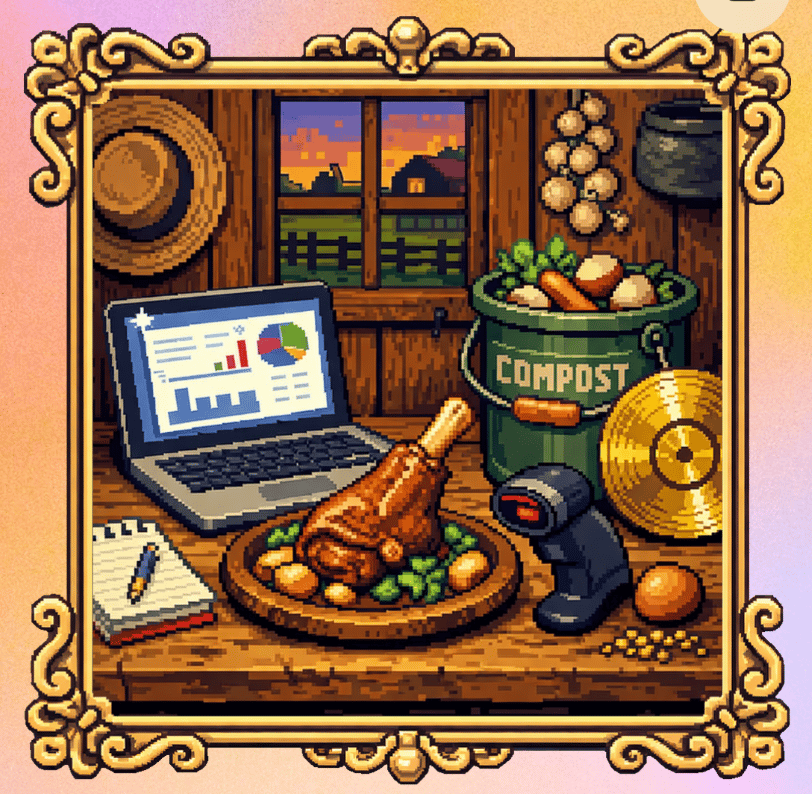
ChatGPT does a year-end review to show you how you performed in 2025… See mine below, they actually nailed it. Farm vibes, automated tools, lots of meat processing, a barcode scanner. Lol.

Tim Ferris and Bill Gurley Outline AI Thesis in 14 Minutes
Great video if you’re on the fence about AI being the next best thing, or just a big overhyped bubble.
The summary is this:
The AI moment isn’t a simple split between true believers and doomers. Like every major technological shift, it’s arriving as a pair: real innovation alongside intense speculation. There is genuine, world-changing technology being built, but it’s surrounded by hype, circular investment, and risky financial behaviour that will burn many participants.
We’re in a gold-rush phase, where much of what’s being sold won’t last. Most AI companies will still fail, and retail investors face significant risk. The real winners won’t be those with the flashiest models, but those who build durable workflows and apply AI to specific, unglamorous problems in real industries.
The practical takeaway is simple: don’t just invest in AI, learn to work with it. The safest position isn’t avoidance or blind belief, but becoming deeply AI-enabled so your skills compound rather than get displaced.
{{ First name | friend }}, thanks for dropping in again.
Forward this to a friend if you found it useful.
Stay human,
Billy